
(To see other currencies, click on price)
MORE ABOUT THIS BOOK
Main description:
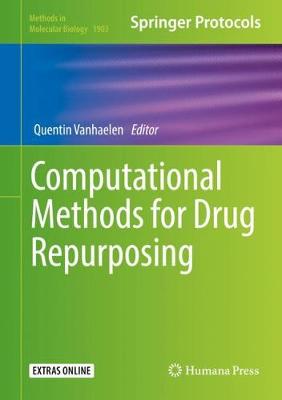
This detailed book explores techniques commonly used for research into drug repurposing, a well-known strategy to find alternative indications for drugs which have already undergone toxicology and pharma-kinetic studies but have failed later stages during the development, via computational methods. Thereby, it addresses the intense challenges of identifying the appropriate type of algorithm and relevant technical information for computational repurposing. Written for the highly successful Methods in Molecular Biology series, the authors of each chapter use their experience in the field to describe the implementation and successful use of a specific repurposing method thus providing lab-ready instruction.
Authoritative and practical, Computational Methods for Drug Repurposing serves as an ideal guide to researchers interested in this vital area of drug development.
Contents:
1. Methods for Discovering and Targeting Druggable Protein-Protein Interfaces and Their Application to Repurposing
E. Sila Ozdemir, Farideh Halakou, Ruth Nussinov, Attila Gursoy, and Ozlem Keskin
2. Performing an In Silico Repurposing of Existing Drugs by Combining Virtual Screening and Molecular Dynamics Simulation
Farzin Sohraby, Milad Bagheri, and Hassan Aryapour
3. Repurposing Drugs Based on Evolutionary Relationships between Targets of Approved Drugs and Proteins of Interest
Sohini Chakraborti, Gayatri Ramakrishnan, and Narayanaswamy Srinivasan
4. Drug Repositioning by Mining Adverse Event Data in ClinicalTrials.gov
Eric Wen Su
5. Transcriptomic Data Mining and Repurposing for Computational Drug Discovery
Yunguan Wang, Jaswanth Yella, and Anil G. Jegga
6. Network-Based Drug-Repositioning: Approaches, Resources, and Research Directions
Salvatore Alaimo and Alfredo Pulvirenti
7. A Computational Bipartite-Graph-Based Drug Repurposing Method
Si Zheng, Hetong Ma, Jiayang Wang, and Jiao Li
8. Implementation of a Pipeline Using Disease-Disease Associations for Computational Drug Repurposing
Preethi Balasundaram, Rohini Kanagavelu, Nivya James, Sayoni Maiti, Shanthi Veerappapillai, and Ramanathan Karuppaswamy
9. An Application of Computational Drug Repurposing Based on Transcriptomic Signatures
Evangelos Karatzas, George Kolios, and George M. Spyrou
10. Drug-Induced Expression-Based Computational Repurposing of Small Molecules Affecting Transcription Factor Activity
Kaitlyn Gayvert and Olivier Elemento
11. A Drug Repurposing Method Based on Drug-Drug Interaction Networks and Using Energy Model Layouts
Mihai Udrescu and Lucretia Udrescu
12. Integrating Biological Networks for Drug Target Prediction and Prioritization
Xiao Ji, Johannes M. Freudenberg, and Pankaj Agarwal
13. Using Drug Expression Profiles and Machine Learning Approach for Drug Repurposing
Kai Zhao and Hon-Cheong So
14. Computational Prediction of Drug-Target Interactions via Ensemble Learning
Ali Ezzat, Min Wu, Xiaoli Li, and Chee-Keong Kwoh
15. A Machine-Learning-Based Drug Repurposing Approach Using Baseline Regularization
Zhaobin Kuang, Yujia Bao, James Thomson, Michael Caldwell, Peggy Peissig, Ron Stewart, Rebecca Willett, and David Page
16. Machine Learning Approach for Predicting New Uses of Existing Drugs and Evaluation of Their Reliabilities
Yutaka Fukuoka
17. A Drug-Target Network-Based Supervised Machine Learning Repurposing Method Allowing the Use of Multiple Heterogeneous Information Sources
Andre C.A. Nascimento, Ricardo B.C. Prudencio, and Ivan G. Costa
18. Heter-LP: A Heterogeneous Label Propagation Method for Drug Repositioning
Maryam Lotfi Shahreza, Nasser Ghadiri, and James Green
19. Tripartite Network-Based Repurposing Method Using Deep Learning to Compute Similarities for Drug-Target Prediction
Nansu Zong, Rachael Sze Nga Wong, and Victoria Ngo
PRODUCT DETAILS
Publisher: Springer (Humana Press Inc.)
Publication date: December, 2018
Pages: 332
Weight: 872g
Availability: Available
Subcategories: Biochemistry