
(To see other currencies, click on price)
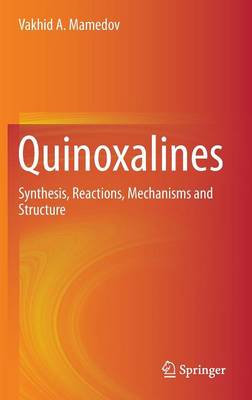
MORE ABOUT THIS BOOK
Main description:
This
book reviews the fundamental aspects of quinoxaline chemistry: synthesis,
reactions, mechanisms, structure, properties, and uses. The first four chapters
present a survey of the developments in quinoxaline chemistry since the
publication of the monograph on "Condensed Pyrazines" by Cheeseman and Cookson
in 1979. These chapters give comprehensive coverage of all the methods of the synthesis of quinoxalines
and the important quinoxaline-containing ring systems such
as thiazolo[3,4-a]-, pyrrolo[1,2-a]-, and imidazo[1,5-a]quinoxalines.
Chapter five describes many new methods for the construction of quinoxaline
macrocycles, which are important in applications such as optical devices and
materials. The final chapter reviews all previously known rearrangements of
heterocyclic systems that lead to benzimidazole derivatives. Mamedov critically
analyses these transformations to reveal a novel acid-catalyzed rearrangement
of quinoxalinones giving 2-heteroarylbenzimidazoles and
1-heteroarylbenzimidazolones in the presence of nucleophilic reactants (MAMEDOV
Heterocycle Rearrangement). This book is of interest to researchers in the
fields of heterocyclic and synthetic organic chemistry.
Contents:
Introduction: Quinoxaline as a Parent Heterocycle.- Synthesis of Quinoxalines.- Synthesis of
Pyrrolo[l,2-a]quinoxalines.- Synthesis
of Imidazo[1,5-a]- and Imidazo[1,2-a]quinoxalines.- Synthesis of
Quinoxaline Macrocycles.- Rearrangements of Quinoxalin(on)es in the Synthesis
of Benzimidazol(on)es.- Appendix.
PRODUCT DETAILS
Publisher: Springer (Springer International Publishing AG)
Publication date: May, 2016
Pages: 300
Weight: 8041g
Availability: Available
Subcategories: Biochemistry